
Convert
Profit Calculator
An editable model of your own practice showing what one extra patient a week does to annual profit.
Live in demo
What it is
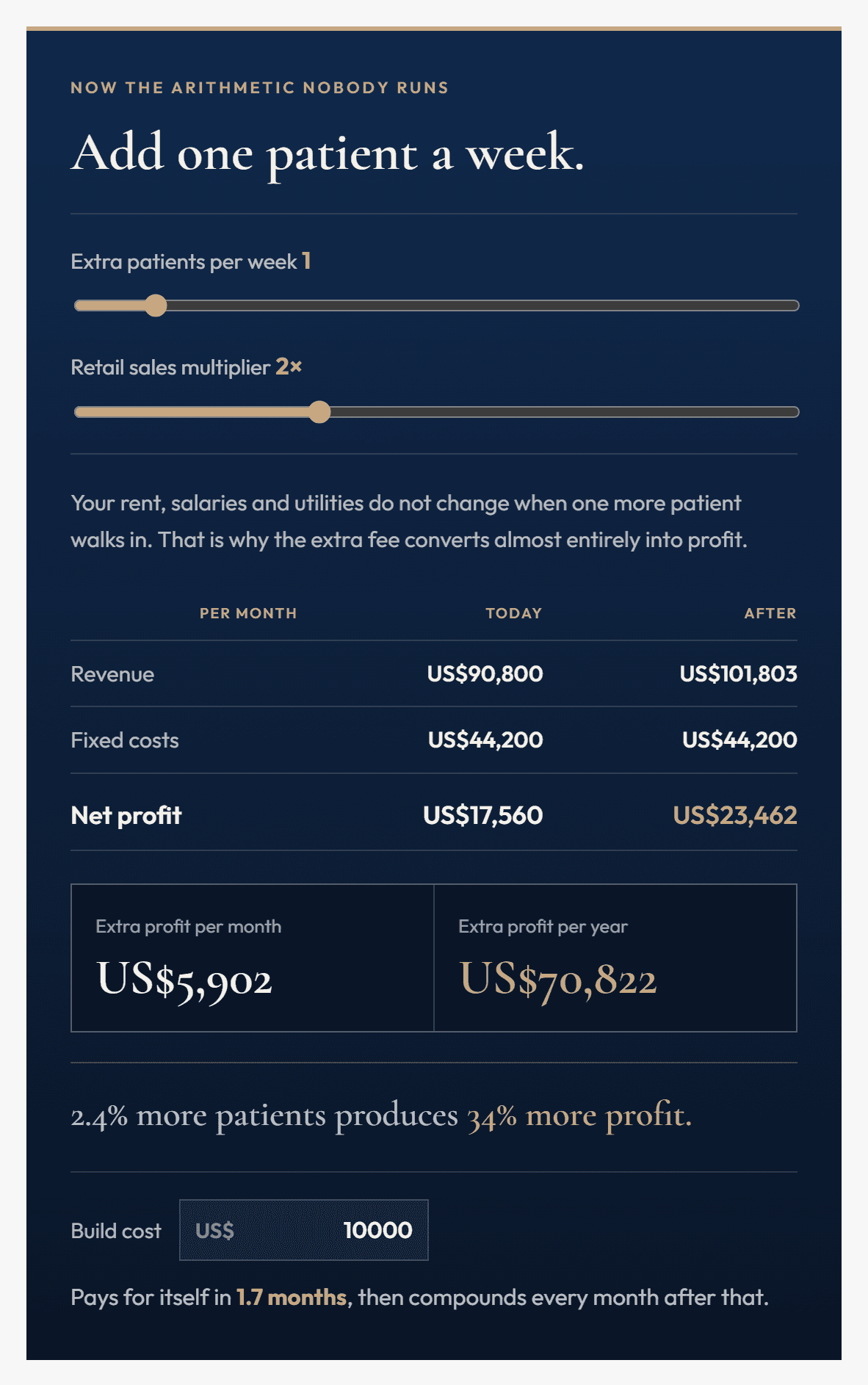
A calculator holding rent, salaries, treatment fees, patient volumes and retail. Every figure starts as an estimate and is meant to be replaced with yours. It then shows what happens to monthly and annual profit if the practice adds a small number of patients per week and improves retail.
Why it matters to your bottom line
- Your fixed costs do not move when one more patient walks in. Rent, salaries and utilities are already paid, so the extra fee converts almost entirely into profit rather than at your average margin.
- That is why a rounding error in patient volume is a landslide in profit. On the example figures, a 2.4% increase in patients produces roughly a 34% increase in annual profit.
- Most owners have genuinely never put this on paper. The number is far larger than intuition suggests, and seeing it changes what a platform investment looks like.
- It also shows payback. If the build recovers a handful of full-fee patients a month, it pays for itself within months rather than years.
How it works here
Replace the figures
Rent, each staff member, each treatment and its monthly volume, retail turnover and your margins. Treatments can be renamed, added or removed.
Set the uplift
Choose how many extra patients a week to model, and what happens to retail.
Read the difference
Monthly and annual profit today against after, with the percentage lift and the payback period.
See it working
This is live on the demo practice — use it rather than take our word for it.
Questions owners ask
- Are these figures a forecast?
- No, and it would be dishonest to present them as one. It is a planning model built on your own numbers to make the size of the opportunity concrete. No result is promised.
- Does anything I type get sent anywhere?
- No. It saves in your own browser and nowhere else. There is no sign-up and no email required.
Related
Want this working in your practice?
A short Discovery conversation is enough to know whether it belongs there — and what it would cost to keep doing without it.